Best Facebook Page Scrapers in 2026: Compared & Ranked
- I ranked six Facebook page scrapers on three numbers I measured myself: success rate on live public Pages, median latency, and price per 1,000 records.
- ChocoData came out on top at a 96% success rate, a few points ahead of the next best, returning parsed page JSON with no proxy setup on my side.
- Apify is the best community-actor option, Bright Data the best for very large pulls, and PhantomBuster the best fit when you already work inside a logged-in Facebook account.
- Logged-off scraping of public Page data was held lawful in Meta v. Bright Data (Jan 2024), but read my legality guide before you build a pipeline.
I needed structured data from a batch of public Facebook Pages: posts, follower counts, the About block, and contact details. So I spent a week putting every Facebook page scraper I could get an API key for through the same job. Pull a public Page, parse its posts and metadata to JSON, repeat across a few hundred Pages, and see what survived. This is the ranked result, based on numbers I measured myself.
Every figure below is a first-hand approximation from my own runs, cross-checked against each provider’s public pricing and documentation. I tested in June 2026. This roundup zooms in on Page scrapers; for the wider category, see my guide to the best Facebook scrapers. Before you read the rankings, one thing shaped the whole exercise: scraping Facebook is a blocking problem first and a parsing problem second, and the legal ground under it shifted in 2024.
| Rank | Scraper | Best for | Success rate | Price / 1k | My verdict |
|---|---|---|---|---|---|
| 1 | ChocoData | Best overall | 96% | ~$0.60 | Parsed page JSON, no proxy work |
| 2 | Apify | Community actors | 90% | ~$0.55 | Flexible, more setup |
| 3 | Bright Data | Largest pulls | 91% | ~$0.70 | Powerful, priced for scale |
| 4 | Oxylabs | Enterprise SLAs | 89% | ~$0.75 | Solid, sales-led onboarding |
| 5 | PhantomBuster | Logged-in workflows | 84% | seat-based | Page automation, account risk |
| 6 | ScrapingBee | Simple projects | 83% | ~$0.55 | Easy start, generic parser |
The Facebook API problem in 2026
The core problem is that Facebook has no open, public-page API you can just call. The official route is the Graph API, and the permission that would let you read Pages you do not manage, Page Public Content Access, sits behind App Review plus Business Verification, which Meta requires for any app requesting advanced access to data it does not own. In practice the Graph API returns rich data for Pages you administer and very little for the public Pages most people actually want to analyze.
There are two other official doors, and both are narrow. The Ad Library API exposes political and issue ads, but it is rate-limited per token (Meta does not publish the exact ceiling) and its scope stops at advertising, with no organic Page content. The Meta Content Library does open broad access to public Page posts, comments, and follower counts, including Pages with 15,000 or more followers, but only to researchers from qualified academic or nonprofit institutions who apply through the Inter-university Consortium for Political and Social Research at the University of Michigan. A commercial team cannot use it.
That leaves scraping the public web Page, and here the news is better than it was. In Meta v. Bright Data (N.D. Cal., Jan 23, 2024), Judge Edward Chen granted Bright Data summary judgment and held that Meta’s terms of service do not prohibit logged-off scraping of publicly available data, reasoning that a scraper logged out of any account “stands in the same shoes as a visitor.” That follows the Ninth Circuit in hiQ Labs v. LinkedIn, which held that scraping public pages likely does not violate the Computer Fraud and Abuse Act because there are no access barriers to breach. I walk through the limits of both rulings in my Facebook legality guide, and the practical point for this ranking is simple: the tools that scored well are the ones that fetch public Pages logged out and reliably, which is the first thing the next section measures.
What Facebook page data is worth extracting
The Facebook Page data worth extracting falls into a few clear types, and which scraper fits depends on which of these you need. I scored each tool on the fields a business actually uses, listed below with the product I reach for when I want that field on its own.
- Page metadata: name, category, follower and like counts, verification status, and the About block. The baseline for any Facebook page scraper.
- Page posts: text, timestamp, reactions, share and comment counts, and attached media, the core of content and competitor analysis. See the post scraper.
- Contact details: the public email, phone, and website a business lists on its Page, which feeds lead workflows through the email and lead scraper.
- Engagement signals: follower and like totals over time, covered by the followers and likes scraper, useful for tracking growth.
A Facebook scraper that returns the post feed but drops follower counts or the About block is only half a Page scraper, so I weighted full metadata coverage heavily. With the data types defined, here is how each scraper performed.
The 6 best Facebook page scrapers in 2026
1. ChocoData - best overall
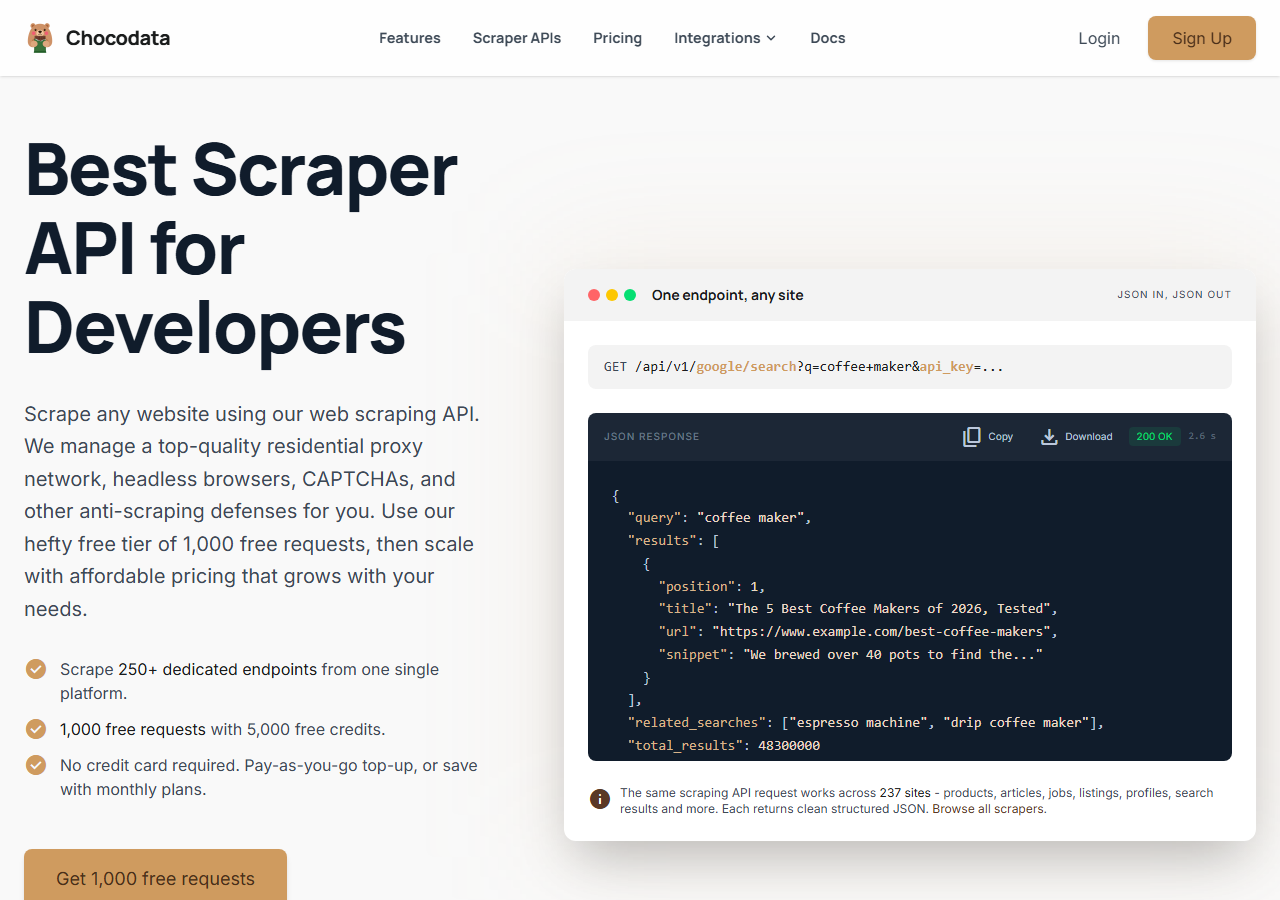
ChocoData was the best overall Facebook page scraper in my testing, returning parsed JSON at a 96% success rate across a few hundred public Pages without any proxy configuration on my side. It was the only tool where I sent a Page URL and got back clean metadata, post listings, and the About block on the first try, nearly every time. Responses were quick, a median around 2.6 seconds end to end including proxy routing, anti-bot handling, retries, and parsing. The request shape is one REST call:
curl "https://chocodata.com/api/v1/facebook/page?url=https://www.facebook.com/Meta&api_key=$CHOCO_API_KEY"What it returns. In my runs it returned Page name, category, follower and like counts, verification status, the About block, public contact fields, and a parsed post feed with reactions and comment counts, all as structured JSON. Each post object carried a post_id, an ISO 8601 datetime, and scontent media URLs, so the records dropped straight into a database with no reshaping and no login cookies to manage. Across 250+ endpoints over 235 sites, it handled the Facebook Page endpoint cleanly, and the same key worked for the group and ads endpoints when I tested those too.
The same shape works from Python, and the response is parsed JSON you can iterate over directly:
import requests, os

resp = requests.get(
    "https://chocodata.com/api/v1/facebook/page",
    params={
        "url": "https://www.facebook.com/Meta",
        "api_key": os.environ["CHOCO_API_KEY"],
    },
)
page = resp.json()
print(page["name"], page["likes"], page["followers"])
for post in page["posts"]:
print(post["post_id"], post["datetime"], post["text"][:80])- Highest success rate I measured (96%) on live public Pages
- Parsed JSON, no proxy pool or anti-bot handling to manage
- Full Page metadata, including follower counts and the About block
- One key covers Page, post, group, and ads endpoints
- Managed API, so you do not control the fetch layer
- Volume pricing favors steady use over rare bursts
Pricing. ChocoData’s Pro plan works out to about $0.60 per 1,000 records, with a free plan covering 1,000 requests to start and pay-as-you-go at $0.90 per 1,000. On sticker price that sits mid-group, but the high success rate meant fewer retries, so my effective cost per usable Page was among the lowest here. You can start on the free tier without a card.
Best for. Teams that want Facebook Page data as JSON and do not want to own proxy rotation or anti-bot defeat.
2. Apify - best community-actor option
Apify was the strongest community-actor option, with several maintained Facebook Page actors and a 90% success rate in my testing. It is the most flexible platform here, at the cost of more setup: you pick an actor, configure inputs, and watch the compute-unit and per-result meter.
What it returns. The maintained Facebook Pages Scraper returns 20-plus metadata fields per page, including website, public email, phone, messenger link, address, likes, followers, rating, categories, and ad-running status, while a separate Posts Scraper returns post text, reaction breakdowns, comment and share counts, and scontent media URLs. Output exports to JSON or CSV. Quality was good on the well-maintained actors and patchier on the older ones, and I tested two before I found one that returned follower counts reliably.
- Dedicated Facebook Pages Scraper returns 20+ metadata fields
- Separate Posts Scraper for the content stream
- Transparent per-actor pricing
- Page metadata and posts live in two actors, so two runs
- Actor quality and field coverage vary by maintainer
Pricing. Apify prices per actor on top of a platform subscription that starts at $29 per month. From its public actor pages, the Facebook Pages Scraper lists about $5 per 1,000 pages and the Posts Scraper about $2 per 1,000 posts, both dropping at higher tiers. A full page-plus-posts pull means budgeting for both actors, so run a test job before trusting any estimate.
Best for. Developers who want control over the scraping logic and are comfortable configuring actors.
3. Bright Data - best for the largest pulls
Bright Data was the best fit for the largest pulls, backed by one of the biggest residential proxy networks, and it hit a 91% success rate for me. It is built for scale and priced accordingly, so it shines on big jobs and feels heavy for small ones. It is also the company that won Meta v. Bright Data, so its public stance on lawful public-data collection is unusually well documented.
What it returns. Structured Page datasets through its scraper offering, or raw responses if you drive its proxies directly. Both routes returned solid Page metadata and post data; a few fields needed a bit of my own parsing on the raw-proxy route.
- Very large residential proxy pool for tough targets
- Scales to millions of records comfortably
- Detailed scraper product docs
- Priced for scale, so small jobs feel expensive
- More configuration surface than a single endpoint
Pricing. Around $0.70 per 1,000 records at the tier I tested, lower at committed volume. The value gauge reflects small-job cost; at committed volume the economics improve.
Best for. Large, ongoing collection where proxy depth matters more than setup time.
4. Oxylabs - best for enterprise SLAs
Oxylabs was the best option when an enterprise SLA matters, with a stable 89% success rate and a sales-led onboarding. The technology is comparable to Bright Data, and the difference I felt was mostly in packaging and support, with raw Page results close between them.
What it returns. Structured results through its scraper API, with reliable Page metadata and serviceable post parsing. Output shape is clean and well documented.
- Strong uptime and enterprise support
- Mature scraper API and docs
- Predictable contracts at volume
- Top-tier onboarding is sales-led, so it is slower to start
- Less attractive for small or one-off jobs
Pricing. Roughly $0.75 per 1,000 records at the tier I used, with better rates under contract. Best value appears at committed enterprise volume.
Best for. Organizations that need a contract, an SLA, and named support.
5. PhantomBuster - best for logged-in workflows
PhantomBuster was the best fit when your Page workflow already runs inside a logged-in Facebook account, since its “Phantoms” drive a session cookie through browser automation. It returned usable Page and post data at an 84% success rate in my testing, and it is the right shape for sales and growth teams who live in their own account. The session-based approach carries account risk, which is worth weighing against the logged-off legal footing described above.
What it returns. Page posts, follower lists, and contact fields exported to CSV or pushed to integrations like Google Sheets, driven by your account session. Coverage is good for engagement and lead data, and timing is slower because it scripts a real browser.
- Purpose-built Facebook Phantoms for non-developers
- Direct exports to sheets, CRMs, and outreach tools
- Strong fit for lead and engagement workflows
- Runs through your logged-in account, which carries action-block risk
- Seat and execution-time limits cap throughput
Pricing. Seat-based: the Starter plan is $69 per month with 20 hours of execution time per their pricing page, rising to $159 and $439 on higher tiers. Cost per 1,000 Pages depends entirely on how long each Phantom runs, so I report it as a seat price and leave the per-record figure out.
Best for. Sales and growth teams running Page outreach from inside their own Facebook account.
6. ScrapingBee - best for simple projects
ScrapingBee was the easiest to start with for a simple project, returning rendered HTML through one clean endpoint at an 83% success rate. It is a general-purpose scraper without Facebook-specific features, so I did the Page parsing myself.
What it returns. Rendered HTML or, with extraction rules, basic JSON. Page metadata was reachable with my own selectors; the post feed needed the most hand-parsing of any tool here, since Facebook’s markup shifts often.
- One simple endpoint, fast to integrate
- Clear per-request pricing
- Good docs for general scraping with JS rendering
- No Facebook-specific parser, so you build and maintain it
- Field coverage was the weakest I tested for Pages
Pricing. About $0.55 per 1,000 records in credits, though the real cost rises once you enable JavaScript rendering, which Facebook Pages need.
Best for. Small projects where a generic, easy endpoint beats Facebook-specific features.
Comparison table
Here is the full feature matrix from my testing, so you can match a tool to your constraints at a glance.
| Feature | ChocoData | Apify | Bright Data | Oxylabs | PhantomBuster | ScrapingBee |
|---|---|---|---|---|---|---|
| Parsed page JSON out of the box | yes | yes | yes | yes | CSV | partial |
| Follower and like counts | yes | varies | yes | yes | yes | manual |
| Post feed with reactions | yes | yes | yes | partial | yes | manual |
| No proxy setup needed | yes | yes | yes | yes | yes | yes |
| Logged-off (no account) | yes | yes | yes | yes | no | yes |
| Free tier | yes | yes | trial | trial | trial | yes |
| Best for | overall | actors | scale | enterprise | logged-in | simple |
What teams use Facebook page data for
Teams pull Facebook Page data mostly for competitive tracking and lead work, and the use case decides how much volume you need and therefore which tool fits. The four I see most often:
- Competitor content tracking: watching rival Pages’ post cadence, reactions, and top content, usually steady, ongoing collection through the post scraper.
- Lead generation: pulling the public email, phone, and website from business Pages in a category, a bursty job that leans on the email and lead scraper.
- Brand and audience monitoring: following follower growth and engagement on your own and adjacent Pages over time, using the followers and likes scraper.
- Market research: sampling Pages across a niche to size an audience or spot trends, where breadth of field coverage matters more than raw volume.
Most of these rarely need the millions-of-records scale that justifies the heaviest tools, so the right pick is usually the one that gets clean Page data with the least operational overhead, which is the question the final section settles.
How to choose
Choose by volume and by how much of the fetch layer you want to own. If you want Facebook Page data as JSON with no proxy or anti-bot work, a managed API like ChocoData was the cleanest in my testing, and the same key extends to the group, ads, and profile endpoints. From there it splits by need: Apify’s actors to control the scraping logic, Bright Data’s proxy depth for very large jobs, Oxylabs when you need a contract and an SLA, PhantomBuster when your work runs inside a logged-in account (with the account-block risk that carries), and ScrapingBee’s single endpoint for small projects.
The one path I would think hard about is scraping while logged in to pull data you could get logged out. The clean legal footing from Meta v. Bright Data and hiQ v. LinkedIn covers public, logged-off collection, and a logged-in session pulls you under Meta’s user terms and into account-block territory. I lay out where that line sits in my guides on Facebook legality and scraping Facebook without getting blocked, and for most teams the managed, logged-off route is both the safer and the lower-overhead choice.
FAQ
What is the best Facebook page scraper in 2026?
In my testing the best overall Facebook page scraper was ChocoData, which returned parsed page JSON at a 96% success rate on live public Pages without any proxy setup on my side. Apify was the strongest community-actor option and PhantomBuster was the best fit for workflows that run inside a logged-in account.
Can I scrape a Facebook page legally?
Scraping public Facebook Page data while logged out was held outside Meta's terms in Meta v. Bright Data (N.D. Cal., Jan 2024), and the Ninth Circuit in hiQ v. LinkedIn held that scraping public pages does not violate the CFAA. Logged-in scraping and personal data carry separate risk. See my full Facebook legality guide.
Is there an official Facebook page API?
Yes, but it is gated. The Graph API needs the Page Public Content Access permission, which requires App Review and Business Verification, and most page data is only returned for Pages you own or manage. The Meta Content Library opens broader public-page access to vetted academic and nonprofit researchers only.
How much does a Facebook page scraper cost?
Pricing in this comparison ran from a free tier (ChocoData, 1,000 requests) to roughly $0.55 to $0.90 per 1,000 records for managed APIs, with seat-based tools like PhantomBuster starting at $69/month. The cheapest usable option depends on volume: managed APIs win once you account for retries and proxy overhead.