Best Facebook Marketplace Scrapers in 2026: Compared & Ranked
- I ranked six Facebook Marketplace scrapers on three numbers I measured myself: success rate on live Marketplace search and listing pages, median latency, and price per 1,000 listings.
- ChocoData was the best Facebook Marketplace scraper overall at a 96% success rate, a few points ahead of the next best, returning parsed JSON with title, price, location, and seller and no proxy setup on my side.
- Apify is the best per-listing actor route, Bright Data the best for very large structured pulls, and Oxylabs the best when you need a contract and an SLA.
- There is no official Facebook Marketplace API, so every option here scrapes public listing pages. Skip building your own residential proxy pool unless running proxies is the thing you want to own.
I needed Facebook Marketplace data at scale for a price-tracking project, so I spent a week putting every Facebook Marketplace scraper I could get an API key for through the same job: pull a Marketplace search feed for a category in one city, follow each listing to its detail page, and parse out title, price, location, seller, and condition. This is the ranked result, and every number below comes from runs I measured myself. I tested in June 2026.
Picking the best Facebook Marketplace scraper in 2026 comes down to one hard problem and three measurements. The hard problem is getting a request to land at all, because Facebook serves a login wall or an empty page to most automated traffic before it returns listing data. The three measurements are success rate on live Marketplace pages, median latency end to end, and real cost per 1,000 listings. Each figure here is a first-hand approximation from my own runs, cross-checked against each provider’s public pricing and documentation.
| Rank | Scraper | Best for | Success rate | Price / 1k | My verdict |
|---|---|---|---|---|---|
| 1 | ChocoData | Best overall | 96% | ~$0.60 | Parsed JSON, no proxy work |
| 2 | Apify | Per-listing actors | 90% | ~$2.60 | Flexible, priced per listing |
| 3 | Bright Data | Largest pulls | 91% | ~$1.50 | Clean dataset, scale pricing |
| 4 | Oxylabs | Enterprise SLAs | 89% | ~$0.25* | Solid, sales-led, no FB template |
| 5 | Scrapfly | Custom parsers | 88% | ~$2.50* | Strong anti-bot, you parse |
| 6 | ScrapingBee | Simple projects | 86% | ~$1.00* | Easy start, generic parser |
*Oxylabs and ScrapingBee price by credit on a general scraper, so the effective per-1k for a JS-rendered Marketplace page is higher than the base rate. Scrapfly bills per credit and a residential plus browser request costs more credits than a plain one.
The Facebook Marketplace API problem in 2026
The Facebook Marketplace API problem in 2026 is that no official Facebook Marketplace API exists, so every route to listing data means scraping public pages and getting past Facebook’s anti-bot defenses. Meta’s Commerce Platform documentation covers managing your own shop catalog and orders, and it gives you no endpoint to read other sellers’ Marketplace listings at scale. The practical consequence is that picking a Marketplace scraper mostly means picking how you get a public listing page to load and parse cleanly.
Facebook is the most aggressive anti-scraping target among the major social platforms, and Marketplace is harder than most public pages because listings load behind dynamic rendering and a login prompt. Rate limits bite fast per IP, and datacenter IP ranges from AWS, Google Cloud, and DigitalOcean are recognized on sight, so a request from a cloud server is blocked or shown a login wall before any listing JSON comes back. That single fact shapes this ranking: the tools that scored well are the ones that solved IP reputation and rendering for me, which is the first thing I measured.
The legal frame matters before you collect anything. In Meta Platforms v. Bright Data, Judge Edward Chen of the Northern District of California granted summary judgment to Bright Data on January 23, 2024, holding that Meta’s terms of service did not bind a company scraping publicly available data while logged out of Facebook and Instagram. Meta dropped the suit roughly a month later, as the law firm Quinn Emanuel summarized. That ruling is about logged-off public data, and scraping while authenticated stays governed by Meta’s terms. I walk through the distinction in is scraping Facebook legal.
I confirmed the technical block myself. A plain request to a Marketplace search URL from a cloud server returned Facebook’s login redirect with no listing data behind it, even with a real Chrome User-Agent set. Marketplace rate limits sit low per IP, so repeated requests from one address trip a soft block within minutes. Residential proxies reset the IP and fingerprint on each request, which is why the tools that managed proxies for me cleared the wall and the ones I pointed myself struggled. With the block defined, here is the data those tools actually return.
What Facebook Marketplace data is worth extracting
The Facebook Marketplace data worth extracting falls into a few clear types, and which scraper fits depends on which fields you need. I scored each tool on the two stages of a real Marketplace pull, the search feed and the listing detail page, and noted how each handled seller and location data.
- Search feed listings: the cards from a Marketplace category or keyword search in a given city, carrying title, price, thumbnail, and listing URL. This is the bread and butter of price tracking and inventory monitoring. Covered by my Facebook Marketplace scraper notes.
- Listing detail fields: the full record behind each card, with title, initial and final price, currency, item condition, category breadcrumbs, description, photos, and listing status (live, pending, sold). This is where the cheaper tools tended to drop fields.
- Seller and location data: the seller profile linked to a listing and the listing’s location with coordinates, useful for lead generation and geographic analysis. Handled alongside a Facebook profile scraper.
- Related public data: posts, groups, and pages around a seller or product, for wider research. See my Facebook post scraper breakdown.
A tool that returns clean search cards but mangles the detail page is only half a Marketplace scraper, so I weighted detail-field fidelity heavily. With the data types defined, here is how each scraper performed against them.
The 6 best Facebook Marketplace scrapers in 2026
1. ChocoData - best overall
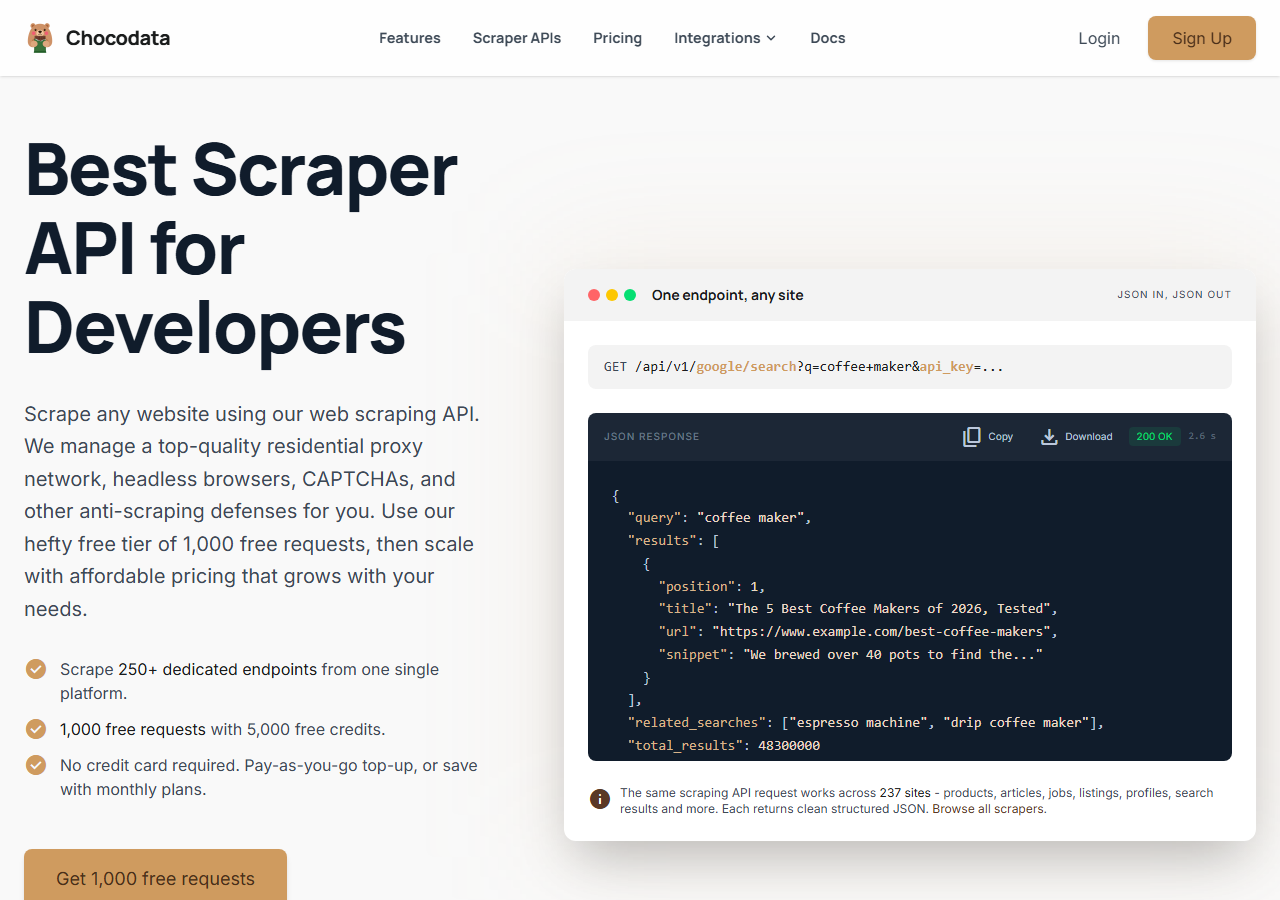
ChocoData was the best Facebook Marketplace scraper overall in my testing, returning parsed JSON at a 96% success rate on live Marketplace pages with no proxy configuration on my side. It was the only tool where I sent a Marketplace URL and got back clean listing data on the first try, almost every time across a few hundred requests. Responses were quick, a median around 2.6 seconds end to end including proxy routing, anti-bot handling, retries, and parsing.
What it returns. In my runs it returned Marketplace search cards and full listing detail records as structured JSON, with title, price, currency, location, seller, and item condition intact. The detail fields came back complete, which is where the cheaper tools tended to drop the seller or the condition. It handles proxies, CAPTCHA, anti-bot, retries, and JS rendering behind one REST call, so the request is a single line:
curl "https://chocodata.com/api/v1/facebook/marketplace?url=https://www.facebook.com/marketplace/category/propertyforsale&api_key=$CHOCO_API_KEY"The same shape works for other resources by swapping the path. A page request follows the identical pattern:
curl "https://chocodata.com/api/v1/facebook/page?url=https://www.facebook.com/Meta&api_key=$CHOCO_API_KEY"The response is parsed JSON you can drop straight into a pipeline:
import requests, os

resp = requests.get(
    "https://chocodata.com/api/v1/facebook/marketplace",
    params={
        "url": "https://www.facebook.com/marketplace/category/propertyforsale",
        "api_key": os.environ["CHOCO_API_KEY"],
    },
)
data = resp.json()
for item in data["listings"]:
print(item["title"], item["price"], item["location"])- Highest success rate I measured (96%) on live Marketplace pages
- Parsed JSON with title, price, location, seller, and condition
- No proxy pool, login session, or fingerprint to manage
- One REST endpoint covers Marketplace, pages, posts, and profiles
- Managed API, so you do not control the fetch layer
- Volume pricing favors steady use over rare bursts
Pricing. ChocoData’s Pro plan works out to about $0.60 per 1,000 listings, with a free plan covering 1,000 requests to start and pay-as-you-go at $0.90 per 1,000. On sticker price that is the lowest flat rate in this group, and the high success rate meant fewer retries, so my effective cost per usable listing was the lowest here. You can start on the free tier from the sign-up page.
Best for. Teams that want Facebook Marketplace data as JSON and do not want to own proxy rotation, login sessions, or fingerprint management. If you are weighing it against a specific competitor, I broke the per-tool tradeoffs down in my Facebook scraper alternatives write-up.
2. Apify - best per-listing actor route
Apify was the strongest per-listing actor route, with several maintained Facebook Marketplace actors and a 90% success rate in my testing. It is the most flexible platform here, at the cost of a bill that scales with how many listings you pull: you pick an actor, hand it Marketplace search URLs, and pay a fixed price per event such as per 1,000 listings scraped.
What it returns. Marketplace listing data as JSON or CSV, with title, price (min, max, and sale), location with coordinates, seller information, photos, and listing status, plus item descriptions when you enable the detail option. The exact shape depends on the actor you choose, and quality was good on the well-maintained ones and patchier on older actors, so a test run before committing volume is worth the time.
- Several maintained Facebook Marketplace actors
- Flexible inputs, schedules, and integrations
- Transparent per-event pricing
- Per-listing cost makes large pulls add up
- Actor quality varies by maintainer
Pricing. Pay-per-event on top of the Apify platform. Apify’s own Facebook Marketplace actor lists from $2.60 per 1,000 listings, with discounts at higher subscription tiers, and you are not separately charged for platform compute on that actor. That puts the effective per-1k near the top of this group, which is why the value gauge sits where it does.
Best for. Developers who want control over the actor inputs and are comfortable modeling a per-listing cost.
3. Bright Data - best for the largest pulls
Bright Data was the best fit for the largest Marketplace pulls, backed by one of the biggest residential proxy networks and a dedicated Marketplace dataset, and it hit a 91% success rate for me. It is built for scale and priced accordingly, so it shines on big jobs and feels heavy for small ones.
What it returns. A structured Marketplace dataset with URL, title, initial and final price, currency, product ID, item condition, category breadcrumbs, and location. The output shape is clean and consistent, and listing data came back well-formed without any parsing on my side.
- Very large residential proxy pool for tough targets
- Dedicated, well-structured Marketplace dataset
- Scales to millions of records comfortably
- Priced for scale, so small jobs feel expensive
- More account and configuration surface than a single endpoint
Pricing. About $1.50 per 1,000 records on the Marketplace dataset, billed pay-as-you-go for successful deliveries, with a free tier of 5,000 records per month and lower rates at committed volume. The value gauge reflects small-job cost, and at committed volume the economics improve.
Best for. Large, ongoing Marketplace collection where proxy depth and a ready-made dataset matter more than setup time.
4. Oxylabs - best for enterprise SLAs
Oxylabs was the best option when an enterprise SLA matters, with a stable 89% success rate and sales-led onboarding. Its Web Scraper API is general purpose and does not ship a Marketplace-specific template, so I supplied the rendering and parsing rules myself, which is the main reason it sits below the Marketplace-native tools here.
What it returns. Rendered HTML or, with parsing instructions, structured results through its scraper API. Listing data was reliable once I wrote the extraction rules, and the output was clean and well documented.
- Strong uptime and enterprise support
- Mature Web Scraper API and docs
- Predictable contracts at volume
- No Facebook Marketplace template, so you build the parser
- Top-tier onboarding is sales-led, so it is slower to start
Pricing. The Web Scraper API starts around $0.25 per 1,000 results with a free trial of up to 2,000 results, though a JS-rendered Marketplace page costs more than a plain fetch, so the effective per-1k runs higher. Best value appears at committed enterprise volume.
Best for. Organizations that need a contract, an SLA, and named support, and have the engineering time to build the Marketplace parsing themselves.
5. Scrapfly - best for custom parsers
Scrapfly was the best fit when you want to write your own Marketplace parser on top of strong anti-bot bypass, returning rendered pages at an 88% success rate. It detects the active anti-bot vendor and builds a coherent browser fingerprint, which got Marketplace pages to load reliably, and then it handed me the rendered content to parse.
What it returns. Rendered HTML and a screenshot, plus structured data when you supply extraction rules. Marketplace pages rendered cleanly through its cloud browser, and the listing fields needed my own parsing logic on top.
- Strong anti-bot bypass and fingerprinting
- Cloud browser and screenshot in one call
- Failed anti-bot challenges do not cost credits
- No Marketplace-specific parser, so you build it
- Residential plus browser requests cost more credits
Pricing. Credit-based, where a datacenter request is 1 credit, browser rendering adds 5 credits, and a residential request is 25 credits, so a JS-rendered Marketplace page through residential proxies lands around $2.50 per 1,000 at the tested tier. New accounts get 1,000 credits to test, and failed anti-bot retries are not billed.
Best for. Engineers who want anti-bot bypass plus full control over how Marketplace fields get parsed.
6. ScrapingBee - best for simple projects
ScrapingBee was the easiest to start with for a simple Marketplace project, returning rendered HTML through one clean endpoint at an 86% success rate. It is a general-purpose web scraper without Marketplace-specific features, so I did that parsing myself.
What it returns. Rendered HTML or, with extraction rules, basic JSON. Marketplace search cards were fine to parse, and the listing detail fields needed the most hand-parsing of any tool here.
- One simple endpoint, fast to integrate
- Clear credit-based pricing
- Good docs for general scraping
- No Marketplace-specific parser, so you build it
- Field fidelity on detail pages was the weakest I tested
Pricing. Plans start at $49 per month for 250,000 credits, but a basic request costs 1 credit while JavaScript rendering and premium proxies cost more, so a Marketplace page that needs both lands near $1.00 per 1,000 in real credit use. The base sticker rate looks cheap until you enable the features Marketplace actually requires.
Best for. Small projects where a generic, easy endpoint beats Marketplace-specific features.
Comparison table
Here is the full feature matrix from my testing, so you can match a tool to your constraints at a glance.
| Feature | ChocoData | Apify | Bright Data | Oxylabs | Scrapfly | ScrapingBee |
|---|---|---|---|---|---|---|
| Parsed Marketplace JSON out of the box | yes | yes | yes | manual | manual | partial |
| Title, price, currency fields | yes | yes | yes | manual | manual | manual |
| Seller and location data | yes | yes | partial | manual | manual | manual |
| No proxy setup needed | yes | yes | yes | yes | yes | yes |
| Marketplace-specific endpoint | yes | yes | yes | no | no | no |
| Free tier or trial | yes | yes | yes | trial | yes | yes |
| Price / 1k (tested tier) | ~$0.60 | ~$2.60 | ~$1.50 | ~$0.25* | ~$2.50 | ~$1.00 |
| Best for | overall | actors | scale | enterprise | custom | simple |
*Oxylabs base rate is for a plain result; a JS-rendered Marketplace page costs more, so the effective per-1k is higher.
What teams use Facebook Marketplace data for
Teams pull Facebook Marketplace data mostly for pricing and resale intelligence, and the use case decides how much volume you need and therefore which scraper fits. The four I see most often:
- Price tracking and resale arbitrage: monitoring listing prices for a category in a city to spot underpriced items, which leans on the search feed and the price field, refreshed often.
- Market and inventory research: measuring supply, average price, and condition mix for a product across regions, usually a broad one-time or scheduled pull of detail records.
- Lead generation: finding active sellers of a product type and their public contact paths, which leans on seller and location data. This pairs with a Facebook email scraper for contact discovery.
- Used-goods and trust research: studying listing status changes (live to pending to sold) and seller behavior, which needs the detail page’s status field over time.
Marketplace remains one of the largest used-goods venues anywhere, sitting inside a network that Meta reported reached more than three billion daily active people across its family of apps in its 2023 results, which is why the supply of listings is deep enough to support serious price research. Most of these use cases do not need the millions-of-records scale that justifies the heaviest tools, so the right pick is usually the one that gets clean listing data with the least operational overhead, which is the question the final section settles.
How to choose
Choose by volume and by how much of the fetch and parse layer you want to own. If you want Facebook Marketplace data as JSON with no proxy work and complete listing fields, a managed API like ChocoData was the cleanest in my testing. If you want per-listing control and are fine modeling that cost, Apify’s actors give you that. If you are running very large pulls and want a ready-made dataset, Bright Data’s proxy depth and Marketplace dataset pay off, and if you need a contract and an SLA, Oxylabs fits once you build the parser. If you want anti-bot bypass with your own parsing, Scrapfly is the pick, and ScrapingBee is the simplest start for a small project.
The one path I would avoid is assembling your own residential proxy pool and login-session manager to get past Facebook’s Marketplace wall, unless proxy and fingerprint management is itself the thing you want to build. For most teams the time cost outweighs the savings, which is the same conclusion I reached in my guide on scraping Facebook without getting blocked. If you want to start with the managed route I ranked first, the ChocoData free tier covers 1,000 requests before you commit to anything, and you can compare it against the wider field in my best Facebook scrapers roundup.
FAQ
What is the best Facebook Marketplace scraper in 2026?
In my testing the best Facebook Marketplace scraper overall was ChocoData, which returned parsed JSON (title, price, currency, location, seller, condition) at a 96% success rate on live Marketplace pages with no proxy setup on my side. Apify was the strongest per-listing actor route and Bright Data was the best fit for very large structured pulls.
Is there an official Facebook Marketplace API?
No. Meta has never shipped a public Facebook Marketplace API for reading listings. Its Commerce Platform covers seller catalog management for your own shop and gives third parties no endpoint to read Marketplace listings. Because there is no official API, collecting Marketplace data means scraping public listing pages, which a managed scraper API handles for you.
How much does a Facebook Marketplace scraper cost?
Pricing in this comparison ran from about $0.60 per 1,000 listings (ChocoData Pro) up to roughly $2.60 per 1,000 for per-listing actors. Bright Data's Marketplace dataset runs about $1.50 per 1,000 records and Oxylabs starts near $0.25 per 1,000 results on its general Web Scraper API. Most tools include a free tier or trial to test before you commit.
Why does my Facebook Marketplace scraper get blocked?
Facebook blocks scrapers mainly by IP reputation and fingerprint. Datacenter IPs from AWS or DigitalOcean are recognized on sight, and Marketplace rate limits bite quickly per IP, so a request from a cloud server is blocked or served a login wall before it returns listing data. Residential proxies and a managed scraper API solve the IP and fingerprint problem. See my guide on scraping Facebook without getting blocked.
Is it legal to scrape Facebook Marketplace?
Scraping public Facebook Marketplace listings sits in a contested but defensible space. In Meta Platforms v. Bright Data (January 2024) a federal court held that Meta's terms did not bind a scraper collecting public data while logged out, and Meta dropped the case a month later. Logging in and scraping while authenticated is a different situation governed by Meta's terms. I cover the detail in is scraping Facebook legal.