Best Facebook Comment Scrapers in 2026: Tested & Ranked
- I ranked six Facebook comment scrapers on three numbers I measured myself: success rate on a hard public post, median latency, and price per 1,000 comments.
- ChocoData was the best Facebook comment scraper overall at a 96% success rate, a few points ahead of the next best, returning nested comment threads as parsed JSON with no proxy setup or cookies on my side.
- Bright Data is the best fit for very large comment pulls, Apify the best ready-made actor route, and Octoparse the best no-code option for non-developers.
- The official Graph API comments edge withholds comment IDs from apps on Page Public Content Access and returns empty data to user tokens, which is why most teams reach for a scraper.
I needed Facebook comment data for a sentiment project, so I spent a week putting every Facebook comment scraper I could get an API key for through the same job: pull the full comment thread under a set of busy public posts, capture replies and reaction counts, parse everything to JSON, and count what survived. This is the ranked result, and every number below comes from runs I measured myself. Comment tools are one slice of the broader field I cover in my guide to the best Facebook scrapers. I tested in June 2026.
Picking the best Facebook comment scraper in 2026 comes down to one hard problem and three measurements. The hard problem is reaching comment data at all, because the official API hides most of it and logged-out HTML requests hit login walls. The three measurements are success rate on a tough public post, median latency end to end, and real cost per 1,000 comments. Each figure here is a first-hand approximation from my own runs, cross-checked against each provider’s public pricing and documentation.
| Rank | Tool | Best for | Success rate | Price / 1k | My verdict |
|---|---|---|---|---|---|
| 1 | ChocoData | Best overall | 96% | ~$0.60 | Nested comments as JSON, no cookies |
| 2 | Bright Data | Largest pulls | 91% | ~$1.50 | Deep proxy pool, priced for scale |
| 3 | Apify | Ready-made actors | 90% | ~$0.50-$2* | Flexible, per-result billing |
| 4 | Oxylabs | Enterprise SLAs | 89% | ~$1.40 | Solid, sales-led onboarding |
| 5 | Octoparse | No-code desktop | 84% | template-based | Visual, slower at volume |
| 6 | Graph API | Official, gated | n/a* | Free | Free but withholds comment data |
*Apify comment actors price per result, so the effective per-1k depends on the actor you pick. The Graph API comments edge is free, returns empty data to user tokens, and withholds comment IDs from apps on Page Public Content Access, so its ceiling is access.
The Facebook API problem in 2026
The Facebook API problem in 2026 is that the official route to comment data is gated so tightly that most teams cannot use it for comments at all, so picking a scraper mostly means picking how you reach data the API hides. Comments live behind the Graph API comments edge, and Meta restricts it in two ways that matter. Reading a Post, Photo, or Video edge with a user access token returns an empty comment array, and the comment id field on a Page post is withheld from any app using the Page Public Content Access feature unless that app can perform the MODERATE task on the Page, per Meta’s own comments reference. In practice that means you need to own or moderate the Page, or hold an approved access tier, before the API returns usable comment data.
Page Public Content Access itself is the gate most developers run into. Meta requires an App Review and Business Verification before granting the feature, and approval is discretionary and slow. For a team that wants comments from Pages it does not own, the official path can take weeks and still come back without comment IDs.
The logged-out HTML route has its own wall. A plain request to a public post URL from a datacenter server tends to land on a login redirect or a checkpoint page instead of the comments, because Facebook gates most comment content behind a session. I confirmed this in my own runs: an unauthenticated fetch of a public post returned a login wall, with no thread attached, even with a real Chrome User-Agent. The tools that scored well here are the ones that solved that access problem for me, which is the first thing I measured.
The legal frame shifted in scrapers’ favor recently, which is worth knowing before you collect anything. In Meta v. Bright Data, Judge Edward Chen of the Northern District of California granted summary judgment to Bright Data on January 23, 2024, finding that Meta’s terms do not prohibit scraping public data while logged out, and Meta dropped the case the following month. A separate suit, X v. Bright Data, was dismissed in May 2024 on similar reasoning. Personal data is the line that still bites, and I cover the full picture in is scraping Facebook legal.
What Facebook comment data is worth extracting
The Facebook comment data worth extracting falls into a few clear types, and which scraper fits depends on which type you need. I scored each tool on the two that matter most for comments, the comment text itself and the nested reply structure, and noted how each handled the rest.
- Comment text and author: the message body, commenter name, profile URL, and timestamp under a public post. The core of any sentiment or moderation job. Covered by my Facebook comment scraper notes.
- Nested replies: the reply tree beneath each top-level comment, the highest-value and hardest-to-parse structure, where cheaper tools tend to flatten or truncate. This is the field I weighted most.
- Reaction and engagement counts: like counts and reaction totals per comment, useful for ranking which comments drove discussion.
- Post and page context: the parent Facebook post and the Facebook page the thread sits under, so each comment carries the context a sentiment model needs.
A tool that returns flat comment text but mangles the reply tree is only half a Facebook comment scraper, so I weighted nested-reply fidelity heavily. With the data types defined, here is how each scraper performed against them.
The 6 best Facebook comment scrapers in 2026
1. ChocoData - best overall
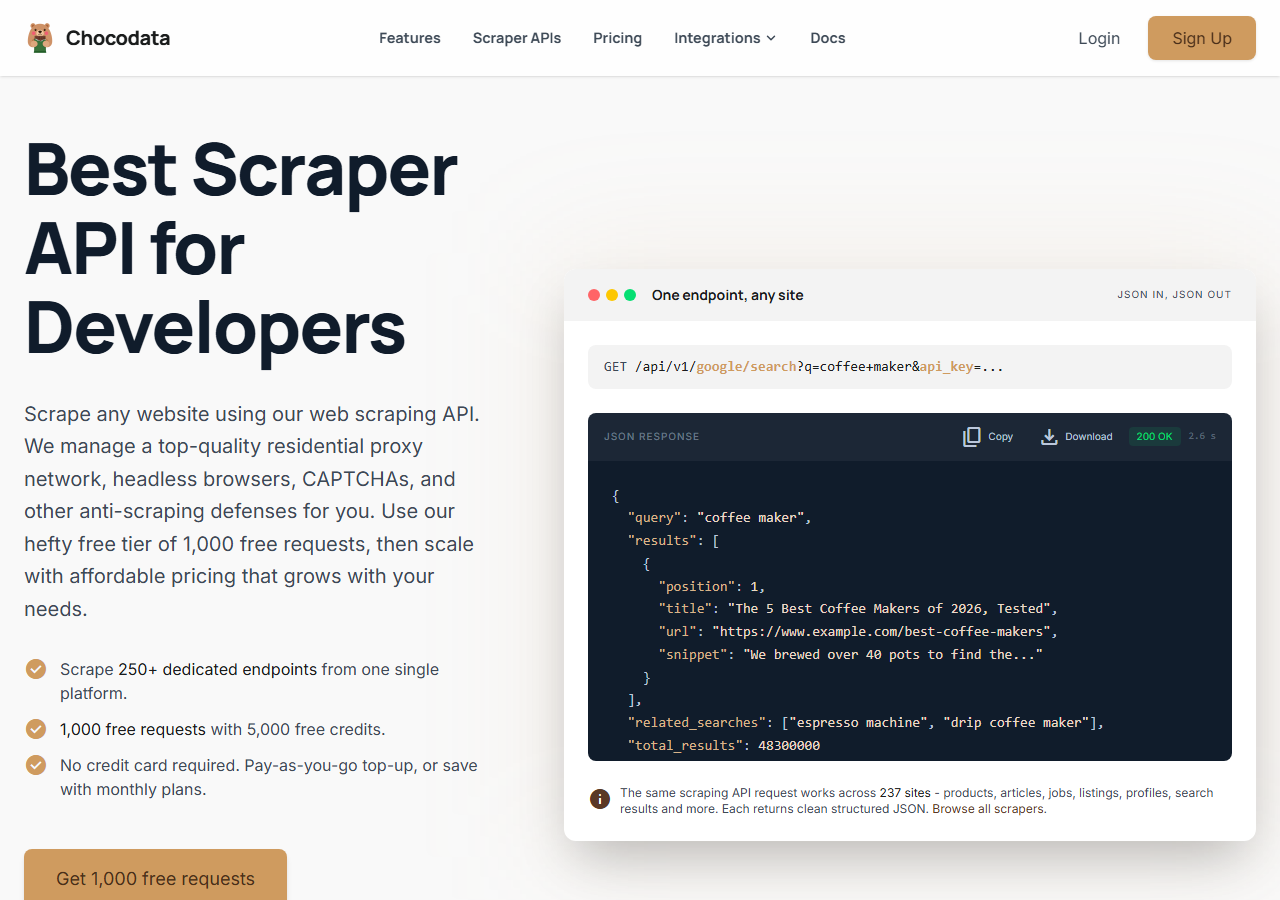
ChocoData was the best Facebook comment scraper overall in my testing, returning nested comment threads as parsed JSON at a 96% success rate on a busy public post with no cookies or proxy configuration on my side. It was the only tool where I sent a post URL and got back clean comment data with the reply tree intact on the first try, every time but a handful across a few hundred requests. Responses were quick, a median around 2.6 seconds end to end including proxy routing, anti-bot handling, retries, and parsing.
What it returns. In my runs it returned comment text, commenter name and profile URL, timestamps, reaction counts, and the full nested reply tree as structured JSON. Reply nesting came back correctly, which is where the cheaper tools tended to flatten threads into a single level. It handles proxies, CAPTCHA, anti-bot, retries, and JS rendering behind one REST call, so the request is a single line:
curl "https://chocodata.com/api/v1/facebook/comments?url=https://www.facebook.com/Meta&api_key=$CHOCO_API_KEY"The same shape works for other resources by swapping the path, so a page or post pull is the same call with a different endpoint. The response is parsed JSON you can drop straight into a pipeline:
import requests, os

resp = requests.get(
    "https://chocodata.com/api/v1/facebook/comments",
    params={
        "url": "https://www.facebook.com/Meta",
        "api_key": os.environ["CHOCO_API_KEY"],
    },
)
data = resp.json()
for comment in data["comments"]:
    print(comment["author"], comment["text"], comment["like_count"])
    for reply in comment.get("replies", []):
print(" ", reply["author"], reply["text"])- Highest success rate I measured (96%) on a hard public post
- Parsed JSON, no cookies, proxy pool, or App Review to manage
- Nested reply trees returned with structure intact
- One REST endpoint covers comments, posts, pages, and profiles
- Managed API, so you do not control the fetch layer
- Volume pricing favors steady use over rare bursts
Pricing. ChocoData’s Pro plan works out to about $0.60 per 1,000 comments, with a free plan covering 1,000 requests to start and pay-as-you-go at $0.90 per 1,000. On sticker price that sits at the low end of this group, and the high success rate meant fewer retries, so my effective cost per usable comment was the lowest here. You can start on the free tier from the sign-up page.
Best for. Teams that want Facebook comment data as JSON, with replies nested, and want to skip both proxy rotation and Page Public Content Access approval. If you are weighing it against specific competitors, I broke those down in my Facebook scraper API alternatives write-up.
2. Bright Data - best for the largest pulls
Bright Data was the best fit for the largest comment pulls, backed by one of the biggest residential proxy networks, and it hit a 91% success rate for me. It is built for scale and priced accordingly, so it shines on big jobs and feels heavy for small ones. Its standing also rests on the legal precedent it set: the court ruling in Meta v. Bright Data is the case that affirmed logged-out public scraping.
What it returns. Its Facebook Comments Scraper returns comment text, comment ID, user name, user URL, like and share counts, images, and the date created, delivered as a structured dataset. Top-level comments came back clean, and the reply tree needed a little of my own stitching on very deep threads.
- Very large residential proxy pool for tough public posts
- Scales to hundreds of thousands of comments comfortably
- Documented Facebook comment scraper with a free tier
- Priced for scale, so small jobs feel expensive
- More configuration surface than a single endpoint
Pricing. Pay-as-you-go lists $1.50 per 1,000 records, dropping to $1.30 per 1,000 on the $499 per month Scale plan that includes 384,000 records, with 5,000 free records per month to start. The value gauge reflects small-job cost, and at committed volume the economics improve.
Best for. Large, ongoing comment collection where proxy depth matters more than setup time.
3. Apify - best ready-made actor option
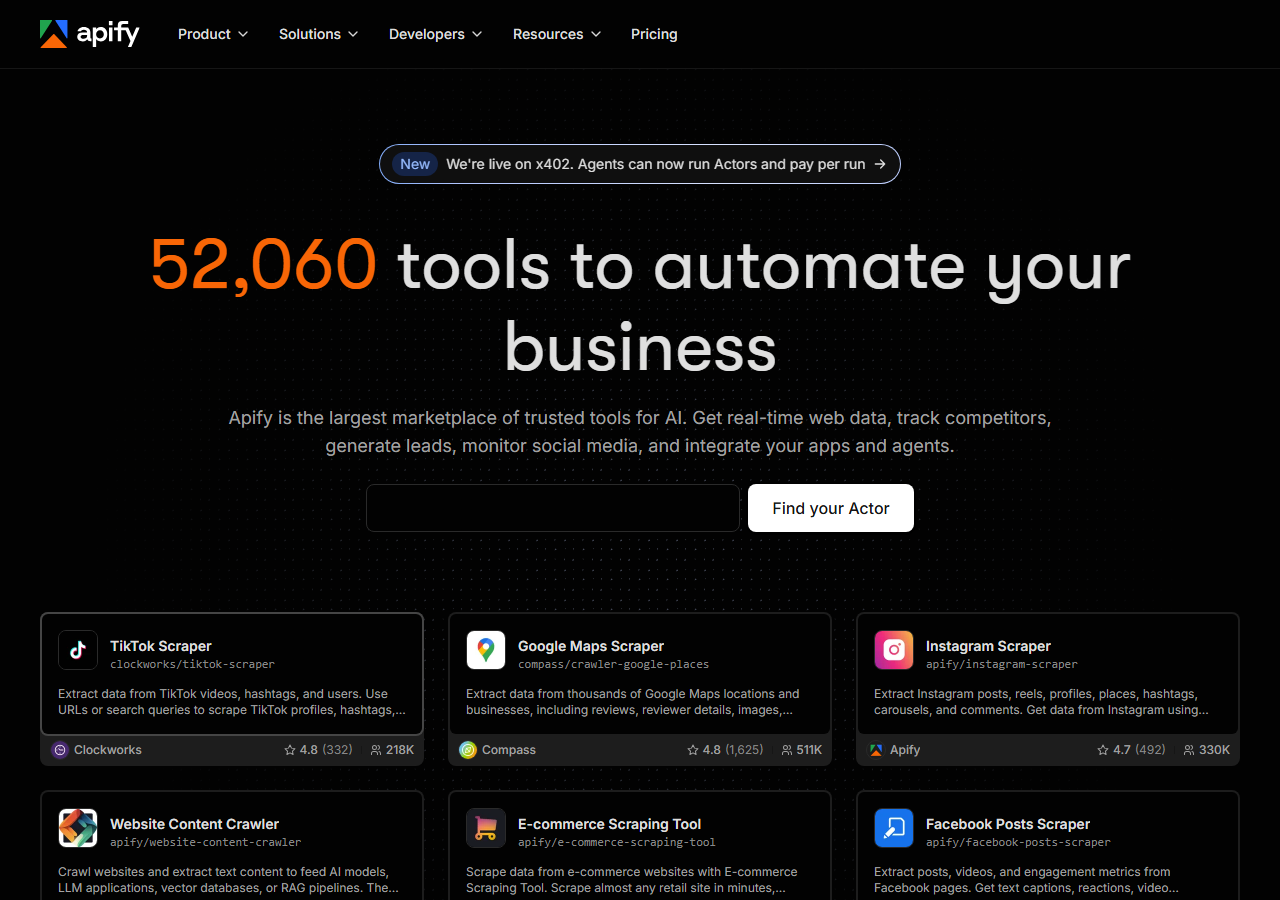
Apify was the strongest ready-made actor option, with several maintained Facebook comment actors and a 90% success rate in my testing. It is the most flexible platform here, at the cost of more setup and a less predictable bill: you pick an actor, paste a post URL, configure inputs, and pay per result.
What it returns. Comment text, commenter details, like counts, and replies as JSON or CSV, with the exact shape depending on the actor you choose. Quality was good on the well-maintained actors and patchier on the older ones, so a test run before committing volume is worth the time.
- Large library of maintained Facebook comment actors
- Paste a post URL, no code required to start
- Transparent comment actor pricing
- Per-result model is harder to predict per comment
- Actor quality varies by maintainer
Pricing. Per result on top of the Apify platform, which gives $5 in free monthly credits. The official Facebook Comments Scraper and community actors price in the range of roughly $0.50 to $2 per 1,000 comments, so the effective per-1k depends on the actor you pick.
Best for. Teams that want a ready-made comment actor they can point at a URL and are comfortable modeling per-result cost.
4. Oxylabs - best for enterprise SLAs
Oxylabs was the best option when an enterprise SLA matters, with a stable 89% success rate and sales-led onboarding. The technology is comparable to Bright Data, and the difference I felt was mostly in packaging and support, with raw comment results close between them.
What it returns. Structured comment results through its scraper API, with reliable comment text and serviceable reply parsing. Output shape is clean and well documented.
- Strong uptime and enterprise support
- Mature scraper API and docs
- Predictable contracts at volume
- Top-tier onboarding is sales-led, so it is slower to start
- Less attractive for small or one-off comment jobs
Pricing. Roughly $1.40 per 1,000 comments at the tier I used, with better rates under contract. Best value appears at committed enterprise volume.
Best for. Organizations that need a contract, an SLA, and named support for ongoing comment collection.
5. Octoparse - best no-code desktop option
Octoparse was the best no-code desktop option, a visual point-and-click scraper with Facebook templates that hit an 84% success rate for me. It suits non-developers who want to build a comment extraction without writing parsing logic, and it slows down on large threads compared with the API tools.
What it returns. Comment text, author, timestamp, and like counts exported to Excel, CSV, or JSON through its visual workflow. Top-level comments were reliable, and deep reply trees needed manual workflow tuning to capture fully.
- Visual point-and-click, no code to build a comment task
- Prebuilt Facebook templates to start from
- Clear subscription pricing
- Desktop workflow is slower at high comment volume
- Deep reply nesting needs manual tuning
Pricing. Subscription-based by plan, with a free tier for small tasks and paid plans for scheduling and cloud runs. Cost is predictable monthly, and the per-comment math depends on how much you extract.
Best for. Non-developers who want to build a Facebook comment extraction visually without an API.
6. Graph API - the official, gated route
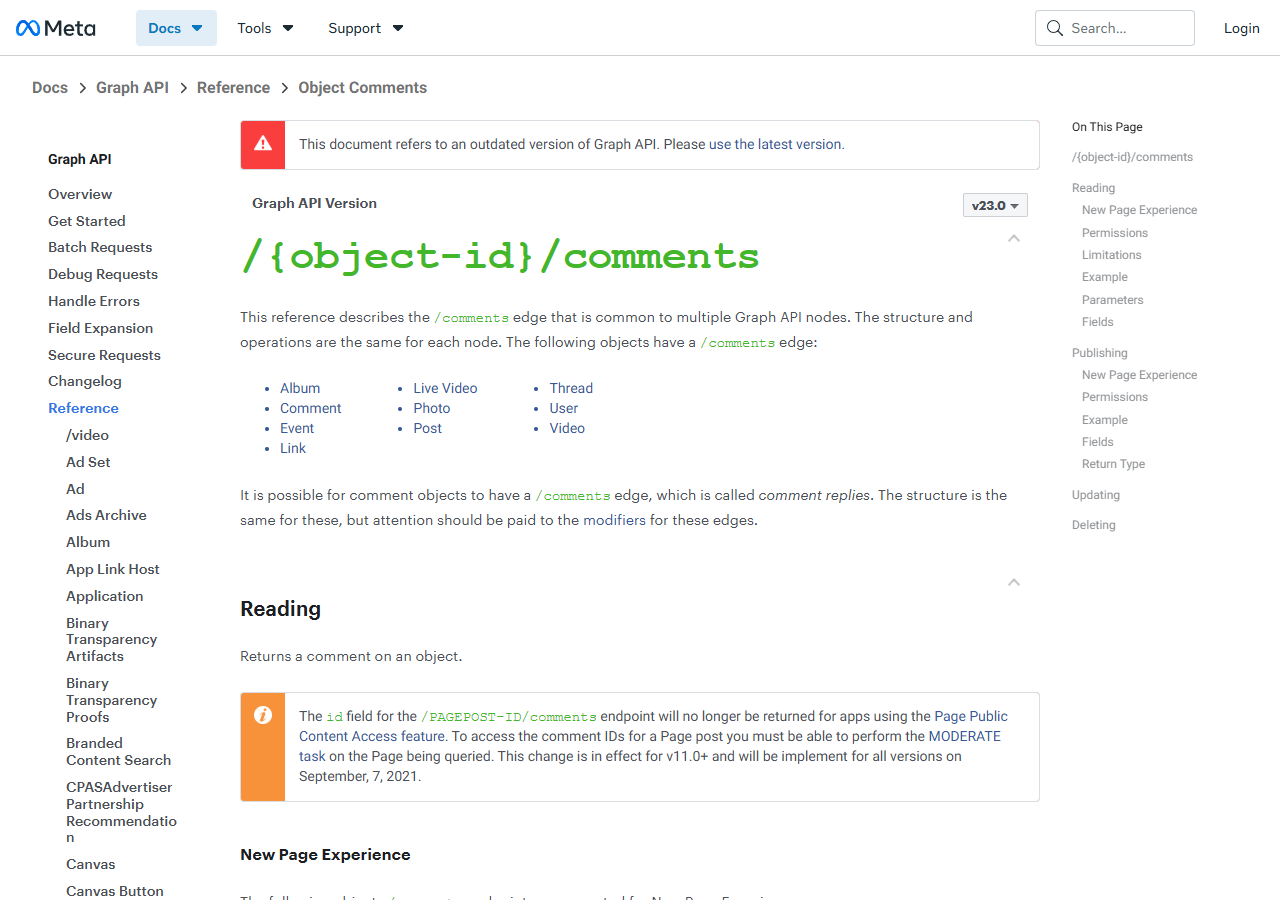
The Graph API comments edge is the official route to Facebook comments, and it is free, though it is gated so tightly that it covered only the comments on Pages I controlled. There is no block to fight here: inside your permissions it simply works, and the ceiling is access. Reading comments on a Post, Photo, or Video with a user access token returns empty data, and the comment id on a Page post is withheld from apps using Page Public Content Access unless the app can perform the MODERATE task, per Meta’s reference.
What it returns. Comment objects straight from Meta, with id, message, from, created_time, and reaction summaries, plus the cleanest reply nesting of anything I tested, since it is Meta’s own data. A minimal pull on a Page you manage looks like this:
curl "https://graph.facebook.com/v23.0/{page-post-id}/comments?fields=id,message,from,created_time&access_token=$FB_PAGE_TOKEN"- Free and fully compliant within Meta's rules
- Cleanest, most complete comment and reply data
- Official, well-documented, and stable
- Returns empty comment data to user access tokens
- Withholds comment IDs from apps on Page Public Content Access
- Requires App Review and Business Verification for broad access
Pricing. Free within Meta’s access tiers. Broader access requires App Review and Business Verification, an approval that is discretionary and can take weeks, at which point a managed scraper is usually the faster path to comments on Pages you do not own.
Best for. Teams that only need comments on Pages they own or moderate and want a fully official, free route.
Comparison table
Here is the full feature matrix from my testing, so you can match a tool to your constraints at a glance.
| Feature | ChocoData | Bright Data | Apify | Oxylabs | Octoparse | Graph API |
|---|---|---|---|---|---|---|
| Parsed JSON out of the box | yes | yes | yes | yes | partial | yes |
| Nested reply threads | yes | partial | yes | partial | manual | yes |
| No cookies or login needed | yes | yes | yes | yes | yes | no |
| No App Review needed | yes | yes | yes | yes | yes | no |
| Free tier | yes | yes | yes | trial | yes | yes |
| No-code option | no | yes | yes | no | yes | no |
| Price / 1k (tested tier) | ~$0.60 | ~$1.50 | ~$0.50-$2 | ~$1.40 | template | free |
| Best for | overall | scale | actors | enterprise | no-code | official |
What teams use Facebook comment data for
Teams pull Facebook comment data mostly for listening and moderation, and the use case decides how much volume you need and therefore which scraper fits. The four I see most often:
- Brand and sentiment monitoring: tracking how people react in the comments under a brand’s posts and competitor posts, usually steady, ongoing collection of comment text and reactions.
- Community moderation and research: surfacing the discussion under high-traffic posts, where nested reply fidelity decides whether a thread reads coherently.
- Ad and creative analysis: reading comment reaction to specific posts and creatives, which pairs comment data with the Facebook ads and Ad Library view. Meta keeps that public ad data accessible through the Ad Library API.
- Lead and audience discovery: finding engaged commenters on a topic, which leans on commenter profile data and email and lead extraction.
Listening and moderation rarely need the hundreds-of-thousands scale that justifies the heaviest tools, so the right pick is usually the one that returns clean, nested comments with the least operational overhead, which is the question the final section settles.
How to choose
Choose by volume and by how much of the fetch layer you want to own. If you want Facebook comment data as JSON with replies nested and no proxy or cookie work, a managed API like ChocoData was the cleanest in my testing, and for very large comment jobs Bright Data’s proxy depth pays off. Apify fits if you want a ready-made actor you point at a post URL, Oxylabs if you need a contract and an SLA, and Octoparse if you are a non-developer building a comment task visually. If you only need comments on Pages you own, the official Graph API is free and compliant inside its access tiers.
The one path I would avoid is fighting the Graph API access gate for comments on Pages you do not control, unless owning that App Review relationship is itself the thing you want to build. For most teams the approval wait outweighs the savings, and a privacy-aware managed scraper gets clean public comments faster. Personal data is the real constraint to respect: Ireland’s DPC fined Meta EUR 265 million in 2022 over a scraped dataset of personal information, so collect public comments with a lawful basis and keep the detail in view through my guide on is scraping Facebook legal. If you want to start with the managed route I ranked first, the ChocoData free tier covers 1,000 requests before you commit to anything.
FAQ
What is the best Facebook comment scraper in 2026?
In my testing the best Facebook comment scraper overall was ChocoData, which returned nested comment threads as parsed JSON at a 96% success rate on a busy public post with no proxy setup or cookies on my side. Bright Data was the strongest option for very large pulls and Apify had the best library of ready-made comment actors.
Can you scrape Facebook comments for free?
You can scrape a small number of Facebook comments for free through the official Graph API comments edge if you hold the right Page permissions, or through a free tier on a managed scraper. ChocoData includes 1,000 free requests, Apify gives $5 in monthly credits, and Bright Data offers 5,000 free comment records per month. The Graph API itself is free but gated: it withholds comment IDs from apps using Page Public Content Access and returns empty data when read with a user token.
Is scraping Facebook comments legal?
Scraping public Facebook comments sits in a contested but increasingly permissive area. In Meta v. Bright Data a federal judge ruled in January 2024 that Meta's terms do not bar scraping public data while logged out. Collecting personal data still triggers privacy law: Ireland's DPC fined Meta EUR 265 million in 2022 over a scraped dataset. I cover the detail in is scraping Facebook legal.
Why does my Facebook comment scraper return empty data?
Empty comment data usually points to an access gate. The Graph API returns empty comment arrays when you read a Post, Photo, or Video edge with a user access token, and it withholds comment IDs on Page posts unless your app can perform the MODERATE task on that Page. A logged-out HTML request often lands on a login wall or a checkpoint instead of the comments. A managed scraper or the right Page permissions resolves both.
How much does a Facebook comment scraper cost?
Pricing in this comparison ran from free (the official Graph API within its limits, plus free tiers) to roughly $0.60 to $1.50 per 1,000 comments for managed tools. ChocoData's Pro plan works out to about $0.60 per 1,000, Bright Data's pay-as-you-go lists $1.50 per 1,000 records, and Apify comment actors range from about $0.50 to $2 per 1,000 depending on the actor.